


Sign up for The Good Stuff
The real stories of what God is doing in the Bay Area and beyond — in your inbox.
In the early 2000s, Amy and I heard about an inclusive soccer program that a few of our friends had started. It was called Exceptional Soccer (or E-Soccer), and it was built on the belief that every person is exceptional—whether they have disabilities or are typically-developing. Our friends believed that including people with disabilities benefits everyone; their vision was to create a place where kids with disabilities could fully participate in youth sports alongside their typically-developing peers and grow into their full athletic and social potential together.
Amy and I didn’t have kids yet, so I can’t say I fully understood the need at the time, but nonetheless we decided to volunteer. From the moment we arrived, we could tell that this idea was something special. Kids with disabilities weren’t on the sidelines—they were in the middle of the action, building friendships, learning, laughing, and growing. The neurotypical kids were right alongside them, developing empathy, patience, leadership, and compassion along with their soccer skills. Everyone was in on the game.
And then there were the families. I could see the relief, gratitude, and the joy of parents watching their kids finally be part of something—not separate, not excluded, but included.
That was the first time my eyes were opened to the life-changing impact we can have on the world around us simply by being kind and including people who are often overlooked. This is how Jesus lived his life:
Jesus went everywhere doing good for people …
Acts 10:38 ERV
Jesus spent his time doing good for everyone, everywhere he went. He moved toward people—especially those who were marginalized or excluded by others. He included them. He made sure they experienced care, not distance. He did this for people regardless of whether or not they chose to follow him. Over the last 25 years, Jesus’s example has motivated us at the BACC to pioneer inclusive programs for people with disabilities. We have built a sustained partnership with E-Soccer and its parent organization, E-Life, so that we can help everyone, everywhere experience the family and friendship that our hearts long for.
Together, we have served thousands of families in the Bay Area and around the world, and collaborated with organizations like UC Berkeley, University of San Francisco, the San Jose Earthquakes, and the Golden State Warriors to promote the inclusion of people with disabilities in all areas of life.
The impact has been big, and over the years it has become deeply personal to me. But like most things, it started small—with two families, a soccer ball, and a neighborhood field. This is the story of how our partnership with E-Life began.
Two families and a field: E-Soccer’s grassroots beginnings
The partnership between the BACC and E-Life began with a friendship between two families. Our Executive Minister, Russ Ewell, is a parent of two sons with disabilities. Russ was talking with a longtime friend, Greg Bodzioch, about wanting his kids to be included in the experience of Saturday morning sports—to develop not only the skills but also the friendships and sense of belonging that come with being part of a team.
At the time, inclusive sports programs where kids with and without disabilities played together were almost unheard of. While some recreational sports organizations offered separate teams for children with disabilities, rarely could the kids on these teams build relationships alongside neurotypical children.
Russ and Greg had seen firsthand the benefits of inclusive friendships in their own families, and since then it has been well documented that inclusion benefits everyone—not only those with disabilities but also those who are neurotypical; it creates empathy, understanding, and friendship.
So they decided to join forces to start something simple and organic. It just so happened that Greg was a former professional soccer player with a similar passion for sports and the experience to coach soccer. They gathered together a small group of friends, families, and coaches on the field of a local middle school one Saturday morning and they played together. Kids with and without disabilities encouraged each other and built friendships while learning how to play soccer.
They didn’t mean to start a program; they just wanted to bring a few families together. But when passersby saw them and found out what they were doing, they wanted to join. People from the church also heard what they were doing and wanted to help. They started showing up every Saturday to volunteer, bring their kids, and stand on the sidelines to support the families.
That little group on a middle school field became E-Soccer. When members of the church at other campuses heard about the impact it made on the community, they were inspired to start E-Soccer programs all over the Bay Area. This heart for inclusion would eventually grow beyond soccer into the launching of other inclusive programs like basketball, gardening, dance, art, and surfing—all of which now comprise the umbrella organization of E-Life.
E-Life programs are not religious. There’s no expectation of belief or church affiliation, and families come from all backgrounds. While many E-Life volunteers may be motivated by their faith, the programs themselves are centered on inclusion, relationships, and community.
God places the lonely in families…
Psalm 68:6 NLT
Through E-Life programs, we want to make the world a better place by making sure that everyone has a friend and no one is left alone.
From E-Soccer to E-Hoops: How inclusion became personal
Years later, the need for inclusion became personal for me. When we learned our son had a neurodiverse diagnosis, I remember struggling to accept reality. I didn’t feel like I had the character, understanding, or knowledge to be the parent he needed. My son couldn’t always participate in the world the way he wanted, and it broke my heart. At times, we felt isolated as a family. Opportunities that we had taken for granted no longer seemed accessible to us.
At that time, another parent told me something I have never forgotten. “The testing and difficulties you’re going through,” he told me, “are because God has a great destiny and dream for your son.”
That changed everything. I realized that what felt like a limitation was actually part of a bigger purpose—for my son, for our family, and eventually for others. I was reminded of the story of Joseph in the Bible, whose life and destiny was shaped through uncertainty, difficulty, and waiting:
Until the time came to fulfill his dreams, the LORD tested Joseph’s character.
Psalm 105:19 NLT
That helped me understand something I couldn’t see at first—God wasn’t just changing our situation; he was changing me.
Without my son, I don’t think I would have grown in empathy, awareness, or compassion in the same way. He opened my eyes to people and needs I might have otherwise passed by, and God had a great purpose for this.
The launch of E-Hoops in San Francisco
In 2013, Amy and I moved to San Francisco and started looking for inclusive activities there for our son. We began volunteering again as coaches at E-Soccer with our son as a participant. We loved it, but it became clear that playing soccer outdoors wasn’t the right fit for him because of his sensory challenges.
At first, that was discouraging. But we believed God was working through it because of verses like this one:
And we know that God causes everything to work together for the good of those who love God and are called according to his purpose for them.
Romans 8:28 NLT
God was working out a good purpose, even in something that felt like a limitation. We realized that there must be other families like us who wanted inclusive programs but could not play soccer. So we asked a simple question: what could we build that would work not just for our son, but for other families like ours?
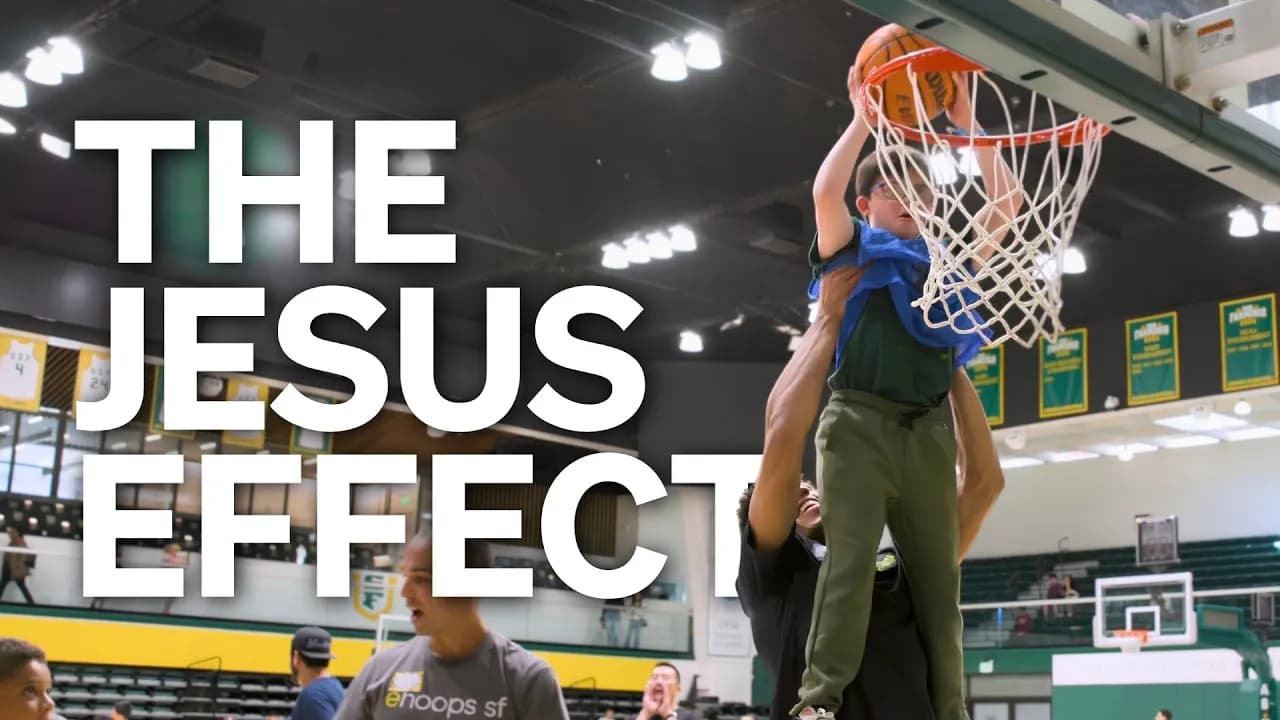
We started praying for an opportunity. Through one of our friends, we got connected with the University of San Francisco (USF) men’s basketball program, and that opened a door we couldn’t have planned. Basketball would not present the same sensory challenges as being outside; it was a more enclosed environment that allowed for focus and attentiveness. We worked with USF, E-Life, and a group of dedicated volunteers in San Francisco to launch an inclusive basketball program called E-Hoops in 2015.
Since 2015, E-Hoops in San Francisco has impacted over a thousand participants, volunteers, and families. Amy and I now serve as directors of the program. We saw the impact personally; our son grew in confidence, built relationships with others, and learned how to be part of a team—so much so that he went on to play and thrive on his middle school basketball team. He is also an E-Hoops coach now, mentoring others with the experiences he had.
Families travel across the Bay Area each weekend because they have found something they couldn’t find anywhere else—a place where their kids are included, known, and valued. One family shared how their son—who was hesitant to try sports—began to grow in confidence, build friendships, and eventually play on his school basketball team, much like our son had.
The USF men’s and women’s basketball teams have been incredible partners for E-Hoops from day one. Their student athletes volunteered as coaches and they opened their facility for us to use. Many of them tell us that they come to give, but they leave changed. Many experience inclusion for the first time in a personal way, and it reshapes how they see people.
That story is repeated across the Bay Area and beyond. Today, over 600 children participate weekly in E-Life activities, supported by more than 500 volunteers, and thousands of families have been impacted over the years.
E-Life makes inclusion a way of life
How deeply intimate and far-reaching is his love! How enduring and inclusive it is! Endless love beyond measurement that transcends our understanding—this extravagant love pours into you until you are filled to overflowing with the fullness of God!
Ephesians 3:18 TPT
Inclusivity is an enduring and exceptional hallmark of God’s love and heart for people. At the core of everything is one simple idea: Inclusion is a way of life.
It goes beyond sports, beyond events, and beyond a single moment. It’s the way we treat people. Inclusion isn’t just about access—it’s about belonging and becoming.
Speak out on behalf of those who have no voice, and defend all those who have been passed over.
Proverbs 31:8 Voice
Inclusion means making someone part of our lives. It’s showing someone that they matter. For many families with disabilities, that kind of space is hard to find. Individuals with disabilities experience higher rates of poverty, isolation, and serious health conditions than those without disabilities. Children with special educational needs are significantly more likely to experience bullying than their peers.
We believe that God’s heart moves toward those who are often marginalized, passed over, or overlooked. He develops the same heart in us as we walk with him, turning us into people who make the world a better place because of our love. This is what we hope to do through our partnership with E-Life.
Many E-Hoops families have told us that they feel something different in the heart of the volunteers in our program. They see the care, experience the consistency, and find a sense of community that’s hard to find elsewhere. I believe that this is because many of our volunteers are motivated by the love of God that they have experienced in their own lives. They want to make other people feel loved, whether they share our religious affiliation or not.
We have also seen that both the neurotypical and neurodivergent kids who participate in our program are changed by the love, consistency, and inclusive relationships they experience. Many kids who experience inclusion become advocates for it in adulthood. We have seen kids grow into mentors, mentors become coaches, and some go on to pursue careers in education, therapy, and community work because of what they experienced. Inclusion becomes part of who they are. Through their empathy and compassion, they make the world a better place.
Growing partnerships and impact
As the impact of E-Life grew, so did the partnerships. The Golden State Warriors began partnering with E-Hoops in 2018, inviting participants to take part in halftime and “primetime” games at the Chase Center. For many families, these moments are unforgettable. One parent told us that playing on the court where the Warriors play was a “dream come true” for their son.
We have also had the privilege of working with the new WNBA Golden State Valkyries, the San Jose Earthquakes, and the University of California, Berkeley, who have come alongside us in this work. Partnerships have also grown with organizations like The Matthew Foundation and the Diablo Valley College basketball team, continuing to expand opportunities for inclusion across the Bay Area.
Over the years, organizations overseas have reached out to us to ask for help starting E-Life programs in their communities. We have helped to launch E-Soccer programs in communities in Kenya, India, China, and the Philippines.
Our vision for E-Life is growing continually. We are working toward building an inclusive community called “Beacon of Hope” for adults with disabilities, who are all too often forgotten—a place and community of relationships where no one feels left out.
Life is exceptional when everyone gets in the game
E-Life and the inclusion of people with disabilities are two examples of the impact that comes from allowing God to shape our hearts. He gives us the desire to speak up for those that the world often overlooks.
While E-Life is not a religious program, it has grown from our understanding of God’s love and our belief that he works through relationships to make the world a better place. To include someone is to make room for them and bring out the best in them—to move toward them instead of past them. That’s the life Jesus lived, and it’s the life we are excited to live too.
Sign up for The Good Stuff
The real stories of what God is doing in the Bay Area and beyond — in your inbox.
 K-LOVESpiritual Resource Ministry, E-Soccer, and E-Hoops all started because one family needed them, and then realized other families did too.
 October 8, 2026
- Discover how the Jesus Effect transforms our community outreach and brings biblical principles to life today.
 October 4, 2026