


Editor’s note:
This is the fifth and final installment in a series called “The New Frontier: Reflections on the Future of the Church. View the entire series here.”
Years of experience have taught me that time is a gift and aging is gain. In the book of Philippians, Paul tells us to forget the past, but that does not mean we cannot learn from it:
No, dear brothers and sisters, I have not achieved it, but I focus on this one thing: Forgetting the past and looking forward to what lies ahead …
Philippians 3:13 NLT
Throughout both my secular life as an agnostic and my spiritual life of walking with God, I have always associated all things big, visible, and influential with success. But the benefits of time have revealed to me the power of Psalm 131: spectacle does not equal impact. This change in perspective has changed me.
My heart is not lifted up; my eyes are not raised too high; I do not occupy myself with things too great and too marvelous for me. But I have calmed and quieted my soul, like a weaned child with its mother; like a weaned child is my soul within me. Israel, hope in the LORD from this time forth and forevermore.
Psalm 131:1–3 NIV
Decades ago I made a deliberate choice—to stop traveling and speaking broadly and to invest deeply in our local church. I chose to invest in relationships, in young leaders and mature leaders, in team leadership, and in serving our fellowship by creating paths to meet the needs of as many people as possible. It was not the most visible path. It was not the approach approved by many who had known me or our church in the past. But it was the path that built lives. What I learned and am still learning—slowly and imperfectly—is that the impact path we were on was the kingdom path.
He also asked, “What else is the Kingdom of God like? [21] It is like the yeast a woman used in making bread. Even though she put only a little yeast in three measures of flour, it permeated every part of the dough.”
Luke 13:20-21 NLT
God’s kingdom isn’t a seismic shock. It isn’t a relentless grind. It isn’t a status-seeking spectacle. It isn’t a hunger for the world’s applause. The world will never exalt God’s kingdom the way we want it to, and the person who has crossed the frontier of impact has made peace with that.
Think instead of Jesus’s description in Luke 13 of a woman kneading a pinch of yeast into a mountain of flour until the two become one. This is the secret rhythm of the kingdom—quiet, patient, and utterly unstoppable. It’s the path of permeation, not visibility.
“This is the secret rhythm of the kingdom—quiet, patient, and utterly unstoppable. It’s the path of permeation, not visibility.”
This mindset is not unfamiliar to me; I also see it in 1 Thessalonians 4:11-12:
… And to make it your ambition to lead a quiet life: You should mind your own business and work with your hands, just as we told you, so that your daily life may win the respect of outsiders and so that you will not be dependent on anybody.
1 Thessalonians 4:11–12 NIV
Though the kingdom life is bold, loving, and uncompromised, it is also patient and wise, which describes the early church that changed the world through the transformed lives of ordinary people (Acts 2:42-47). God values this quiet patience more than flashy might:
It is better to be a patient man than a mighty warrior, better to be someone who controls his temper than someone who conquers a city.
Proverbs 16:32 Voice
I’ve had to learn to be a patient man. I am still learning. God’s kingdom rewards patience in a way the world does not. And God himself modeled this—he does not always take the shortest path, because the shortest path is not always the path that forms us:
When Pharaoh let the people go, God did not lead them on the road through the Philistine country, though that was shorter. For God said, “If they face war, they might change their minds and return to Egypt.”
Exodus 13:17 NIV
God took Israel the long way. Not because he could not have taken them the short way, but because the short way would have broken them before they were formed enough to handle what was ahead. The longer path was the forming path. The longer, forming path is about base hits, not home runs. It’s not all at once, but little by little. This is not a failure of vision. It is the wisdom of a God who knows that the people he is forming need to be built before they can be sent.
Simon Peter, a servant and apostle of Jesus Christ, to those who through the righteousness of our God and Savior Jesus Christ have received a faith as precious as ours: Grace and peace be yours in abundance through the knowledge of God and of Jesus our Lord. His divine power has given us everything we need for a godly life through our knowledge of him who called us by his own glory and goodness. Through these he has given us his very great and precious promises, so that through them you may participate in the divine nature, having escaped the corruption in the world caused by evil desires.
2 Peter 1:1–4 NIV
God’s divine power forms us and has given us everything we need for a godly life of impact through our knowledge of him. Not through our effort, platform, or visibility, but through our knowledge of him. This is the foundation of genuine impact; it’s not what we build for God, but what God produces through people who know him. And knowing him produces something specific:
For this very reason, make every effort to add to your faith goodness; and to goodness, knowledge; and to knowledge, self-control; and to self-control, perseverance; and to perseverance, godliness; and to godliness, mutual affection; and to mutual affection, love. For if you possess these qualities in increasing measure, they will keep you from being ineffective and unproductive in your knowledge of our Lord Jesus Christ.
2 Peter 1:5–8 NIV
Effective and productive in your knowledge of our Lord Jesus Christ. This is what spiritual formation produces—not impressive religious activity, but lives that bear real fruit because they are genuinely connected to the source. And the warning that follows is equally important:
But whoever does not have them is nearsighted and blind, forgetting that they have been cleansed from their past sins. Therefore, my brothers and sisters, make every effort to confirm your calling and election. For if you do these things, you will never stumble, and you will receive a rich welcome into the eternal kingdom of our Lord and Savior Jesus Christ.
2 Peter 1:9–11 NIV
“Nearsighted and blind, forgetting they have been cleansed from their past sins.” These are the words Peter uses for the person whose formation has stalled—who has the knowledge of God in their head but not the qualities of God forming in their life. Formation that does not advance our life is not spiritual formation. It is religious accumulation. Impact is the evidence that formation is real.
“Formation that does not advance our life is not spiritual formation. It is religious accumulation. Impact is the evidence that formation is real.”
Impact is the by-product of the other three spiritual qualities discussed earlier in this series that distinguish a Christian who follows Jesus. While we may possess devotion, conviction, and vision, without impact we must question whether the other three qualities are truly spiritually formed within us.
Any Christian can attempt to pursue impact without a walk with God and settle for influence instead. Influence is what we build. Impact is what God produces through us. They are not the same thing, and confusing them is one of the primary ways any person—in any position, at any stage of the walk—loses God in the midst of the work.
The church, when it practices spiritual formation and participates in the transformative purposes of God, becomes what Peter Senge calls a “learning organization.” This is not an institution that manages programs but a living community of people being constantly formed, equipped, and grown into something greater than what they could produce on their own. Paul described it two thousand years before Senge put it into organizational language:
So Christ himself gave the apostles, the prophets, the evangelists, the pastors and teachers, to equip his people for works of service, so that the body of Christ may be built up until we all reach unity in the faith and in the knowledge of the Son of God and become mature, attaining to the whole measure of the fullness of Christ.
Ephesians 4:11–13 NIV
Attaining to the whole measure of the fullness of Christ is not an organizational goal. It is a formation goal. The church exists to produce that kind of person—not a better version of the person who walked in, but someone formed into the fullness of Christ. That is the destination of spiritual formation. And that destination produces the kind of impact the world cannot replicate through any secular formation system.
Then Jesus came to them and said, “All authority in heaven and on earth has been given to me. Therefore go and make disciples of all nations, baptizing them in the name of the Father and of the Son and of the Holy Spirit, and teaching them to obey everything I have commanded you. And surely I am with you always, to the very end of the age.”
Matthew 28:18–20 NIV
“Make disciples.” In a world desperate for spiritual formation, Jesus is the answer. In a world desperate for identity, Jesus is the answer.
Jesus’s words in these verses are often called the Great Commission. But beneath the familiar language is something more inspiring than a command and more personal than church membership. It is an invitation into destiny.
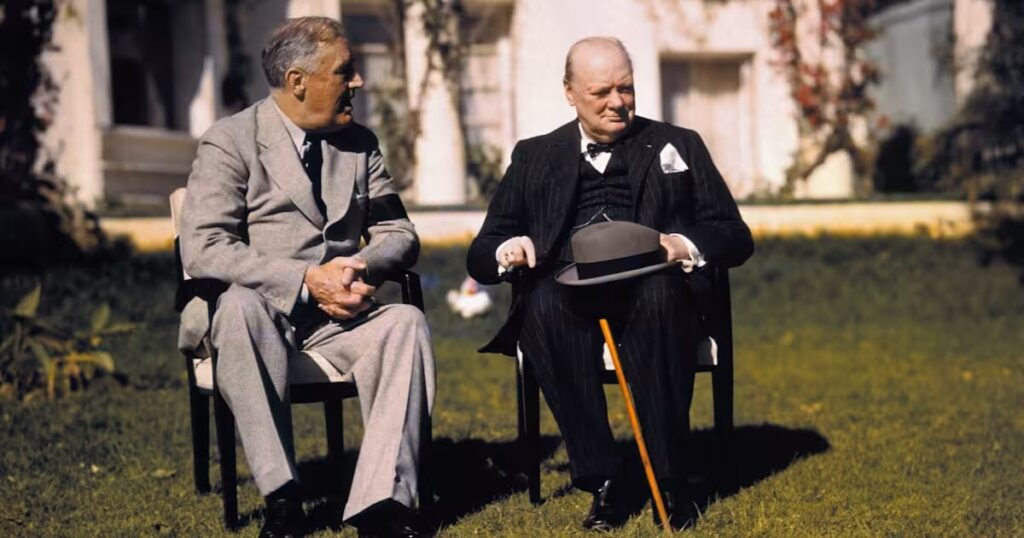
When FDR spoke of a “rendezvous with destiny” and when Churchill described his ascension to the prime ministership as the fulfillment of a purpose he had always known was his—they were reflecting something that lives in every human being: a sense that there is something you were made for. Something that, when you find it, feels less like a decision and more like a calling. Reading Andrew Roberts’s Churchill: Walking with Destiny and H.W. Brands’s Traitor to His Class showed me that this hunger for purpose was not incidental to Churchill or FDR’s greatness—it was the engine of it. And it is the same hunger that God designed into every person who has ever lived.
That is what making disciples is actually about. Not membership. Not affiliation. Not compliance with a doctrinal checklist. It’s about destiny and the formation of a person—from the inside out, through a walk with God—into someone whose life is aligned with the purpose God had in mind before they were born.
And here is what makes it extraordinary: God does not leave that formation to chance or to our own effort.
Being confident of this, that he who began a good work in you will carry it on to completion until the day of Christ Jesus.
Philippians 1:6 NIV
He who began a good work in us will carry it on to completion. This is formation with a purpose that God himself guarantees. Not a destination we reach by trying harder. A work he finishes in us—in this life and into eternity, because when Jesus returns it is complete.
This is what being a Christian and a disciple actually means. It is not a title, or a category of membership, or a badge of doctrinal correctness. It is a type of person—a person being formed.
This is the person the New Frontier is calling into being. This is the rendezvous with destiny that every searching soul has always felt but never been able to name.
I planted the seed, Apollos watered it, but God has been making it grow. So neither the one who plants nor the one who waters is anything, but only God, who makes things grow.
1 Corinthians 3:6–7 NIV
When a person plants and waters with this sense of purpose—not anxious about their impact, but confident that God is at work in what they cannot see—this is the faithfulness of destiny. A confidence like this is inspired by a walk with God that produces something the world cannot manufacture: a person so freed from self-protection and self-promotion that their ordinary life becomes extraordinary in God’s hands. This is the type of person who finds a life of faith freeing, not restrictive.
It is for freedom that Christ has set us free. Stand firm, then, and do not let yourselves be burdened again by a yoke of slavery.
Galatians 5:1 NIV
Christianity is about freedom. Freedom from self-deception (John 8:31-32 NIV), freedom from the self-destructiveness of sin (Romans 6:22 NLT), the complete freedom Jesus promises from everything in this life that limits and enslaves (John 8:36 NIV).
“Christianity is about freedom.”
When we don’t experience this freedom, Scripture makes clear the reasons why.
Such regulations indeed have an appearance of wisdom, with their self-imposed worship, their false humility and their harsh treatment of the body, but they lack any value in restraining sensual indulgence.
Colossians 2:23 NIV
They have lost connection with the head, from whom the whole body, supported and held together by its ligaments and sinews, grows as God causes it to grow.
Colossians 2:19 NIV
This is the contrast Paul draws throughout his letters. Religious regulations that look spiritual but produce no genuine change enslave rather than free—they make us disconnected from the head, disconnected from Christ, who is the source of all growth.
Destiny and restriction cannot coexist. Compliance without transformation produces people who find Christianity restrictive and constraining—not because God is restrictive, but because a life of religious performance without genuine interior change offers no freedom, no joy, and no real reason to stay. What people experience as constraint is not God. It is the absence of him.
When the connection to the head is restored—when a walk with God replaces religious regulation as the source of life—what once felt burdensome becomes the most liberating experience available to a human being (1 John 5:3). What changes our lives is not joining a spiritual community in order to be validated. What changes our lives is being formed by God until we actually want what he wants—and discovering that what he wants is the most liberating thing we have ever desired.
A person liberated by God is a person available to God. That availability is what produces impact— not strategy, scale, or human effort.
“That availability is what produces impact— not strategy, scale, or human effort.”
Nothing can hinder the Lord from saving, whether by many or by few (1 Samuel 14:6). The size of the harvest belongs to God (Matthew 9:37-38). The faithfulness of the planting belongs to us (1 Corinthians 3:5-6).
The impact path for the church
At the Bay Area Christian Church, our two missions that express our sense of purpose are making God known and doing good. These are not programs we run but the natural expression of people being genuinely formed by a walk with God. Through these missions, God continues to guide us down the path of impact.
Making God known flows through all nine of our campuses across the Bay Area, through small groups meeting throughout the week, through college and teen ministries helping young people discover God for themselves, and through online resources like Deep Spirituality and “The Spiritual Frontier” which reach the searching and the skeptical across the digital world.
Doing good flows through community service initiatives we have started and partnerships we have built. E-Life and E-Sports are programs we support to serve people with disabilities and promote full inclusion. Digital Scribbler advances technology that gives voice to those who cannot speak for themselves. Our Holiday Toy Drive was started in 2008 and has brought over 22,000 toys to kids in need throughout the Bay Area. We started by partnering with A Better Way to serve children in foster care throughout the Bay Area and have since expanded to partner with agencies in every county that serve underprivileged youth. We have also built an ongoing partnership to support the Office of Violence Prevention in Stockton, consistently supporting them in their efforts to bring real change to their community and individual people’s lives.
In addition to these partnerships, we have countless member-led initiatives in our local communities to serve the underserved. Members of the church meet regularly to collect and deliver needed items for people experiencing homelessness in San Jose. Others distribute “bags of love” with food and essential items for the unhoused in San Francisco.
Doing good is not a strategy. It is not evangelism in disguise. It is the natural expression of people who have been genuinely transformed by a walk with God. You do not have to believe what we believe to receive what we give. We serve because of who we are, not because of who you are or are not.
“You do not have to believe what we believe to receive what we give. We serve because of who we are, not because of who you are or are not.”
For you have not received a spirit of slavery leading to fear again, but you have received a spirit of adoption as sons and daughters by which we cry out, “Abba! Father!”
Romans 8:15 NASB
The old metrics of behavioral Christianity measured attendance and membership. The spiritual metrics are devotion, conviction, vision, and impact. Religious duty enslaves us and produces people who comply. Spiritual family produces people who are transformed and who love. The difference is not organizational. It is the difference between the letter and the Spirit—the oldest and most important spiritual distinction in the history of the church, and the one that matters most right now.
The invitation
I began this series by telling you about room 328B, where a curious young man searching through great thinkers discovered that God was the answer to every question he was carrying. I want to close by telling you that the answer has not changed. God is real. He is interested in you. He has been behind the tapestry of your life all along—placing eternity in your heart (Ecclesiastes 3:11), claiming you as his own, appointing you beforehand according to the purpose of him who works everything in agreement with the counsel and design of his will (Ephesians 1:11).
The New Frontier is not a church program. It is not a vision document. It is an invitation to every person—the Christian who has been walking with God for decades and needs to press on further, the person who left institutional Christianity and has never stopped aching for something real, the searcher who felt the pull of Ecclesiastes 3:11 and has been moving toward it without knowing what it is:
He has made everything beautiful and appropriate in its time. He has also planted eternity [a sense of divine purpose] in the human heart [a mysterious longing which nothing under the sun can satisfy, except God]—yet man cannot find out (comprehend, grasp) what God has done (His overall plan) from the beginning to the end.
Ecclesiastes 3:11 AMP
It is a call to cross the only frontier that ultimately changes everything: the frontier of the heart. Behavior changes actions, but spirituality changes us.
The spirituality of Jesus is a walk with God that transforms who we are, how we live, what we see, what we build, and how we love. It is the only spirituality that has ever genuinely changed the world—not through institutional dominance or cultural conquest but through the quiet, permeating, unstoppable transformation of ordinary human lives. And it is available to anyone willing to walk.
If you abide in Me and My voice abides in you, anything you ask will come to pass for you. Your abundant growth and your faithfulness as My followers will bring glory to the Father.
John 15:7–8 Voice
Abide. Ask. Abundant growth. Glory to the Father. That is the sequence. That is the promise. That is the New Frontier—not a destination we reach by trying harder, but a territory we enter by walking with God. Not a frontier only for the spiritually mature or the institutionally positioned. A frontier for every person who is willing to stop moving as before, look up, and begin to seek the God who is not far from any of us.
We live in a globalized, interconnected, and yet profoundly lonely world with an unknown future, but the upheaval of the 21st century is not a threat to the church or to the Christian life. It is the very ground on which God’s message spreads to new frontiers and attracts more and more people — exactly as it did in the first century, when upheaval was the context in which the church was born, and a walk with God was the only thing that made the difference (Acts 12:24).
The person who keeps moving forward by faith enters the spiritual frontier—where discovery never ends, God’s purposes unfold, and ordinary lives become the means through which God changes the world.
The church that stops moving forward has already stopped believing. Belief moves. It always has. So wherever you are—believe, or believe again. Move forward. Embrace the New Frontier. A world desperate for genuine change is waiting for people like you who are willing to walk with God.
 Fox NewsWhat they need isn't shame but invested adults who will walk alongside them, help turn their goals into real plans, and show them their lives matter.
 October 4, 2026
 Religious News ServicesThe numbers on Gen Z showing up to church are real and encouraging, but attendance isn't conviction.
 September 4, 2026